
Physical Gold Dealers
1. APMEX (American Precious Metals Exchange)
Owning physical gold can serve as a reliable hedge against inflation, providing stability and security in times of financial uncertainty. APMEX operates as one of the largest online precious metals retailers in North America, offering gold coins, bars, and rounds from government mints and private refiners. Their inventory includes popular investment-grade gold options like American Gold Eagles and Canadian Maple Leafs, as well as collectible numismatic pieces.
The platform provides real-time pricing based on spot gold rates, educational resources for beginners, and secure shipping with insurance.
2. JM Bullion
JM Bullion specializes in bullion products with some of the lowest premiums in the industry. They focus on grade A gold bullion (meaning the purest investment form) rather than collectibles, which keeps costs down for buyers seeking pure gold content.
The company ships free on orders over $199 and offers a price match guarantee.
Their inventory tracking system shows real-time availability, preventing backorder frustrations.
3. SD Bullion
SD Bullion built its reputation on transparent pricing and minimal markups. The website clearly displays premiums relative to the spot price, making comparison shopping straightforward.
They offer a best price guarantee and often run promotions on popular gold products.
Customer service operates 7 days a week and maintains an A+ BBB rating.
4. Kitco
Kitco combines precious metals dealing with comprehensive market news and analysis. Beyond selling gold products, they provide real-time charts, expert commentary, and market research. Investors can benefit from this information by making informed decisions quickly. For example, an investor might read Kitco’s latest market analysis highlighting an upward trend in gold prices and immediately place an order for gold bars or coins to capitalize on the favorable market conditions. Their physical gold offerings include bars, coins, and wafers in various sizes, providing flexibility for different investment strategies. The platform serves both new investors and experienced traders who want market intelligence alongside purchasing options.
5. GoldSilver.com
GoldSilver.com caters specifically to investors using precious metals for wealth protection and portfolio diversification. Founded by Mike Maloney, an influential figure in the precious metals realm, the platform emphasizes education through videos, articles, and guides about monetary history and economic cycles. Maloney’s acclaimed book series on precious metals investing and his documentary series, which has reached millions worldwide, enhance the credibility and authority of GoldSilver.com’s educational materials.
They sell investment-grade bullion at transparent prices and offer vault storage for customers who prefer not to store gold at home.
Gold ETFs and Exchange-Traded Products
6. SPDR Gold Shares (GLD)
GLD is the largest and most liquid gold ETF, holding gold in secure vaults. Each share equals a fraction of an ounce.
You can buy and sell shares instantly during market hours through any brokerage account.
The fund charges an annual expense ratio of 0.40%, akin to paying a modest insurance premium to manage portfolio risk. The ETF gives investors gold exposure without the need to store physical gold and is suitable for those making regular purchases through dollar-cost averaging.
7. IShares Gold Trust (IAU)
IAU functions similarly to GLD but with a lower 0.25% expense ratio, making it more cost-effective for long-term holders. The lower fee structure particularly benefits retirement accounts, where every basis point matters over the long term.
BlackRock manages the fund and stores the physical gold in secure facilities.
Share prices run lower than GLD, which some investors prefer psychologically, even though the percentage returns remain comparable.
8. Aberdeen Standard Physical Gold Shares ETF (SGOL)
SGOL stores gold in Switzerland, offering diversification beyond the typical London and New York storage locations and providing a margin of safety due to Switzerland’s political stability. Its 0.17% fee is among the lowest, aligning with Graham’s safety-first principle by emphasizing cost-effectiveness beyond mere price comparison.
Swiss storage appeals to investors concerned about jurisdictional risk or who want gold holdings outside the United States.
9. VanEck Merk Gold Trust (OUNZ)
OUNZ lets investors take physical delivery if they hold enough shares, bridging the gap between paper gold and physical ownership.
The fund charges an annual fee of 0.40%. The option for physical gold delivery eliminates the need to store it at personal locations, providing added convenience.
This option suits investors who want ETF convenience with the option to convert to physical gold.
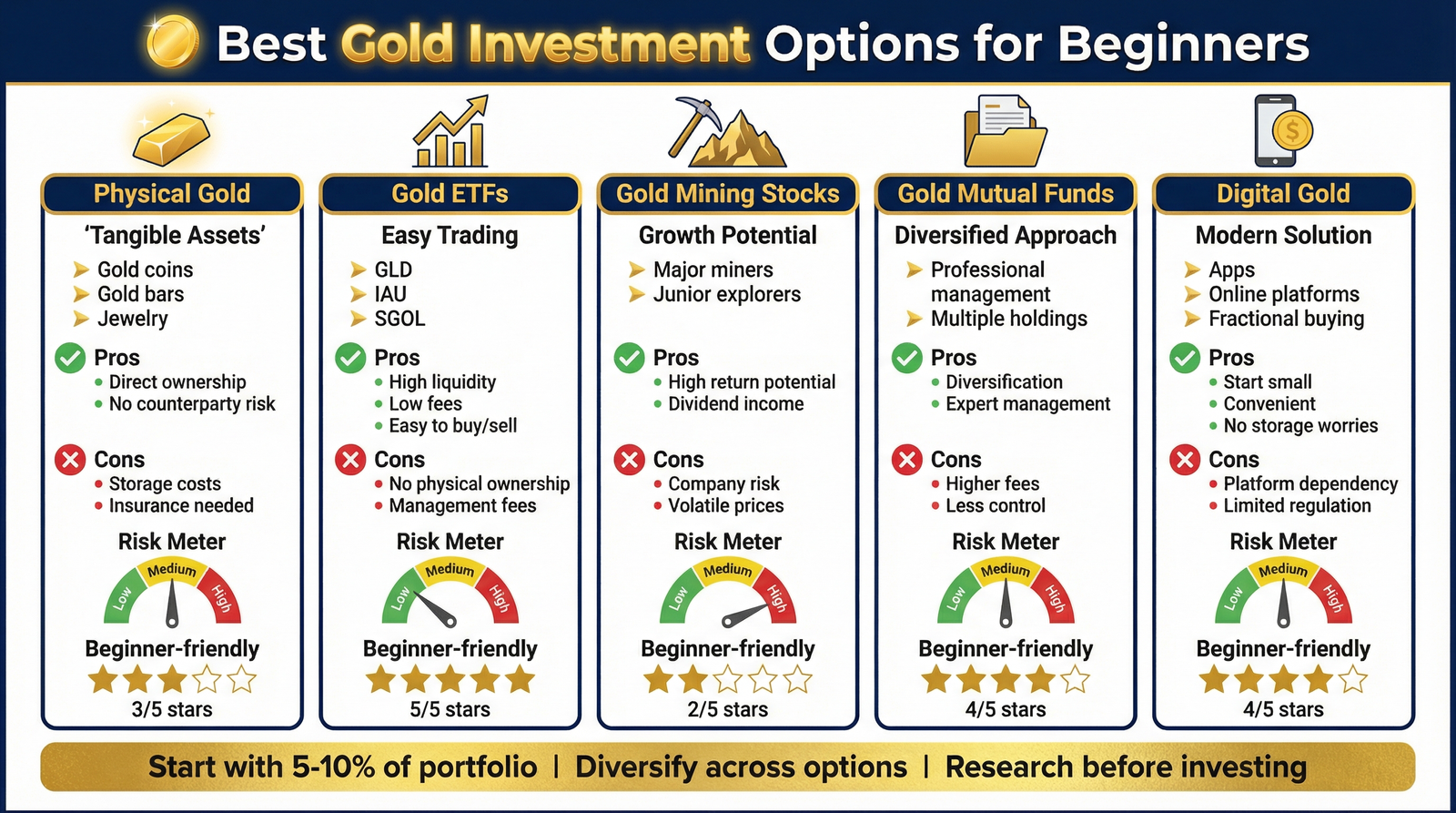
Gold IRA Providers
10. Augusta Precious Metals
Augusta Precious Metals specializes in Gold IRAs and silver IRAs with a focus on customer education. As “The Retirement Metals Coach,” they assign each customer a dedicated specialist who explains the rollover process, IRS regulations, and product options.
Augusta has earned high ratings for transparency and has received zero BBB complaints for eligible issues.
Their least investment starts at $50,000, positioning them for serious retirement savers.
11. Goldco
Goldco handles both Gold IRA rollovers and direct purchases of physical precious metals. They walk customers through transferring funds from existing 401(k) or IRA accounts into self-directed precious metals IRAs.
They provide IRS-approved storage and a buyback guarantee.
Their customer service team focuses on explaining tax implications and compliance requirements.
12. Birch Gold Group
Birch Gold Group has been in operation since 2003, helping investors diversify their retirement accounts with precious metals. They work with many custodians and depositories, giving customers choices about where their gold is stored. The company emphasizes education through market guides and one-on-one consultations.
They handle rollovers from traditional IRAs, Roth IRAs, 401(k)s, and other retirement accounts.
Gold Mining Stocks and Funds
13. Newmont Corporation (NEM)
Newmont is the world’s largest gold mining company, with operations across many continents. The stock provides leveraged exposure to gold prices because mining company profits rise when gold prices rise. However, it’s also important to note that Newmont’s profitability can be heavily influenced by operating costs, particularly fuel and labor expenses. Understanding these cost cycles helps provide a disciplined, Graham-style analysis of Newmont’s financial performance.
Newmont also pays dividends, adding an income component that physical gold cannot provide.
The company’s size and geographic diversity reduce some of the risks inherent in smaller mining operations.
14. Barrick Gold Corporation (GOLD)
Barrick Gold is a top global producer with low costs and large reserves. The company has strengthened its finances in recent years.
Barrick offers exposure to gold price appreciation, plus operational improvements and potential dividend growth.
15. VanEck Gold Miners ETF (GDX)
GDX holds a diversified portfolio of gold mining companies rather than physical gold, providing exposure to the sector without single-company risk. The fund includes major producers such as Newmont and Barrick, as well as mid-tier miners. Historically, GDX has approximately twice the volatility of bullion, meaning it can offer substantial gains in rising markets but also poses greater risk during downturns. Understanding this variability is crucial for making informed investment decisions, especially for those with a lower risk tolerance.
The ETF charges 0.51% annually and trades with high liquidity.
16. Fidelity Select Gold Portfolio (FSAGX)
This actively managed mutual fund invests at least 80% of assets in gold-related securities, including mining companies and physical gold. Professional managers choose stocks they believe will outperform the broader gold sector.
The fund charges higher fees than passive ETFs at around 0.77% but aims to deliver alpha through active selection.
This works for investors who prefer professional management over passive index tracking.
Digital Gold Platforms
17. Vaulted
Vaulted allows you to buy physical gold stored in insured vaults with investments starting at just $10. You own actual allocated gold stored at the Royal Canadian Mint, not paper claims or shares.
The platform charges 0.40% annually for storage and insurance with no transaction fees.
You can take physical delivery at any time by paying the shipping costs. This democratizes gold ownership for younger investors or those testing the waters.
OneGold is the result of a partnership between APMEX and Sprott, combining retail expertise with institutional storage solutions. You purchase fractional amounts of physical gold, silver, and platinum stored in secure vaults. Recently, a user shared their experience of converting their digital gold ounces into a physical gold bar delivered straight to their door, highlighting OneGold’s flexibility. The option to seamlessly transition from digital to physical assets caters to various investment strategies, offering peace of mind to investors who prefer tangible holdings.
The platform provides both allocated (specific bars assigned to you) and unallocated (pooled) storage options. Pricing stays competitive with real-time spot rates plus small premiums. You can convert digital holdings to physical products shipped to your door.
The platform provides both allocated (specific bars assigned to you) and unallocated (pooled) storage options. Pricing stays competitive with real-time spot rates plus small premiums. You can convert digital holdings to physical products shipped to your door.
Gold Certificates and Alternative Options
19. Perth Mint Certificate Program
The Perth Mint in Australia issues certificates representing physical gold stored in its facilities. These certificates offer a unique advantage: they are backed by the Western Australian government, effectively serving as built-in counterparty insurance. This sovereign guarantee acts as a risk-transfer mechanism for investors, providing peace of mind and anchoring the safety of certificates in established risk theory. This assurance makes the Perth Mint Certificate Program appealing to international investors seeking gold exposure with an added layer of security.
You can purchase unallocated certificates (lower cost) or allocated certificates (specific bars).
The program works for international investors seeking gold exposure outside the North American jurisdiction.
20. Kinesis Money
Kinesis operates a digital currency backed by physical gold and silver, combining precious metals with blockchain technology. Each KAU unit represents one gram of allocated gold stored in insured vaults.
You can spend Kinesis currency through debit cards or transfer between users.
The platform pays yields to holders and users based on system activity. This suits tech-savvy investors seeking gold-backed cryptocurrency-like functionality.
Making Your Choice
After reviewing these options, my personal favorite for beginners is Augusta Precious Metals. The combination of low fees, instant liquidity, and no storage hassles makes it the simplest entry point for most people. To turn this preference into action, consider setting a calendar alert for tomorrow to explore Augusta Precious Metals further. This small step can help channel your enthusiasm into a tangible commitment.
That said, your situation might call for something different. If you value holding physical gold, start with JM Bullion for their low premiums.
If you’re focused on retirement tax advantages, investigate iShares Gold Trust (IAU) or Goldco.
If you want leveraged exposure to gold prices, consider GDX.
The important step is starting. Viewing hedging as a disciplined process, like rebalancing a portfolio, rather than a bet on disaster, aligns with Graham’s counsel to focus on control over foresight. Gold allocation protects your portfolio from inflation and market volatility, but only if you actually apply the strategy. Open an account with one of these providers this week.
Make your first purchase, even if small. You can always add more later or diversify across many platforms as your understanding grows.
Gold investing stopped being complicated the moment you decided to research your options. You now have 20 vetted pathways to gold ownership.
Pick one that matches your goals and take action.
Frequently Asked Questions
What’s the least amount needed to start investing in gold?
Minimums vary by platform. Vaulted accepts just $10, making gold accessible to nearly everyone.
Gold ETFs like IAU or GLD need only the price of one share, typically $20-40.
Physical gold purchases need more capital since even a one-ounce gold coin costs over $3,500 at 2025 prices. Gold IRA providers often set minimums between $10,000-$50,000.
Choose your platform based on how much you can comfortably allocate right now.
Should I choose physical gold or gold ETFs?
Physical gold means tangible ownership, giving you possession and the assurance that it will function even during system failures, but it requires secure storage and insurance. You pay premiums when buying and accept discounts when selling. ETFs, on the other hand, offer convenience with instant liquidity, no storage concerns, and lower costs, though you hold shares instead of the actual metal. Most investors find ETFs beneficial, unless they need the peace of mind or emergency preparedness that comes with holding physical metal.
Are Gold IRAs worth the extra complexity and fees?
Gold IRAs make sense if you’re maximizing retirement contributions and want precious metals exposure in tax-advantaged accounts. The setup fees and annual storage costs typically add up to $200-$400 per year.
However, the tax benefits can outweigh these costs, especially for high earners in Traditional IRAs or those seeking tax-free growth in Roth IRAs. Skip Gold IRAs if you’re young with small retirement balances or if you’re not maxing out regular IRA contributions first.
How do I verify a gold dealer is legitimate?
Check their Better Business Bureau rating and read actual customer reviews across many platforms like Trustpilot, Reddit, and Google. Legitimate dealers clearly display their business address, licensing information, and contact details.
They provide authentication certificates with purchases and offer reasonable buyback policies.
Avoid dealers who use high-pressure sales tactics, offer prices significantly below market rates, or request unusual payment methods, such as wire transfers to foreign accounts.
Yes, gold prices fluctuate based on market conditions, currency values, inflation expectations, and investor sentiment. Someone who bought gold at its 2011 peak, around $1,900 per ounce, waited years to see profits. During the period from September 2011 to December 2013, gold prices fell by approximately 28%, dropping to about $1,200 per ounce. This decline highlights the potential risks of mistimed investments, underscoring the importance of understanding gold’s volatility.
However, gold has maintained purchasing power over decades and centuries, unlike currencies that consistently lose value to inflation.
Treat gold as a long-term hedge rather than a short-term speculation, and accept that some years will show negative returns.
Financial advisors typically recommend a 5-15% allocation to gold based on your risk tolerance and concerns about inflation. However, it’s essential to personalize this recommendation and consider your own “sleep-at-night” threshold. Conservative investors comfortable with traditional stocks and bonds might keep their allocations around 5%, while more cautious individuals could find peace of mind in a higher percentage. Deciding where you fall within this range fosters a sense of ownership over the decision, aligning with Graham’s emphasis on matching investment strategies to your character and personal temperament.
Those worried about currency devaluation or economic instability might go as high as 15%. Avoid putting more than 20% in gold unless you have specific reasons, since gold doesn’t generate income or dividends like stocks and bonds. Diversification across asset classes remains crucial for long-term wealth building.
How quickly can I sell my gold investments if needed?
ETFs and digital gold platforms offer near-instant liquidity during market hours through your brokerage account or platform interface. Physical gold requires finding a buyer, shipping the product, and waiting for payment, which can take days to weeks.
Local coin shops provide faster sales but often at lower prices.
Gold IRAs have the slowest liquidity since you must request distributions from your custodian and potentially pay penalties for early withdrawals before age 59½. Match your gold investment options with Gold IRAs to meet your liquidity needs.
Gold IRAs have the slowest liquidity since you must request distributions from your custodian and potentially pay penalties for early withdrawals before age 59½. Match your gold investment options with Gold IRA’s to meet your liquidity needs.
Still Unsure Where to Start? Answer a few quick questions to see which type of gold investment fits your goals best.